Sunday, January 15, 2017

Dead Zoos & Green Deserts


Jet-lagged Kyle is SUPER excited about Ireland's National Natural History Museum!

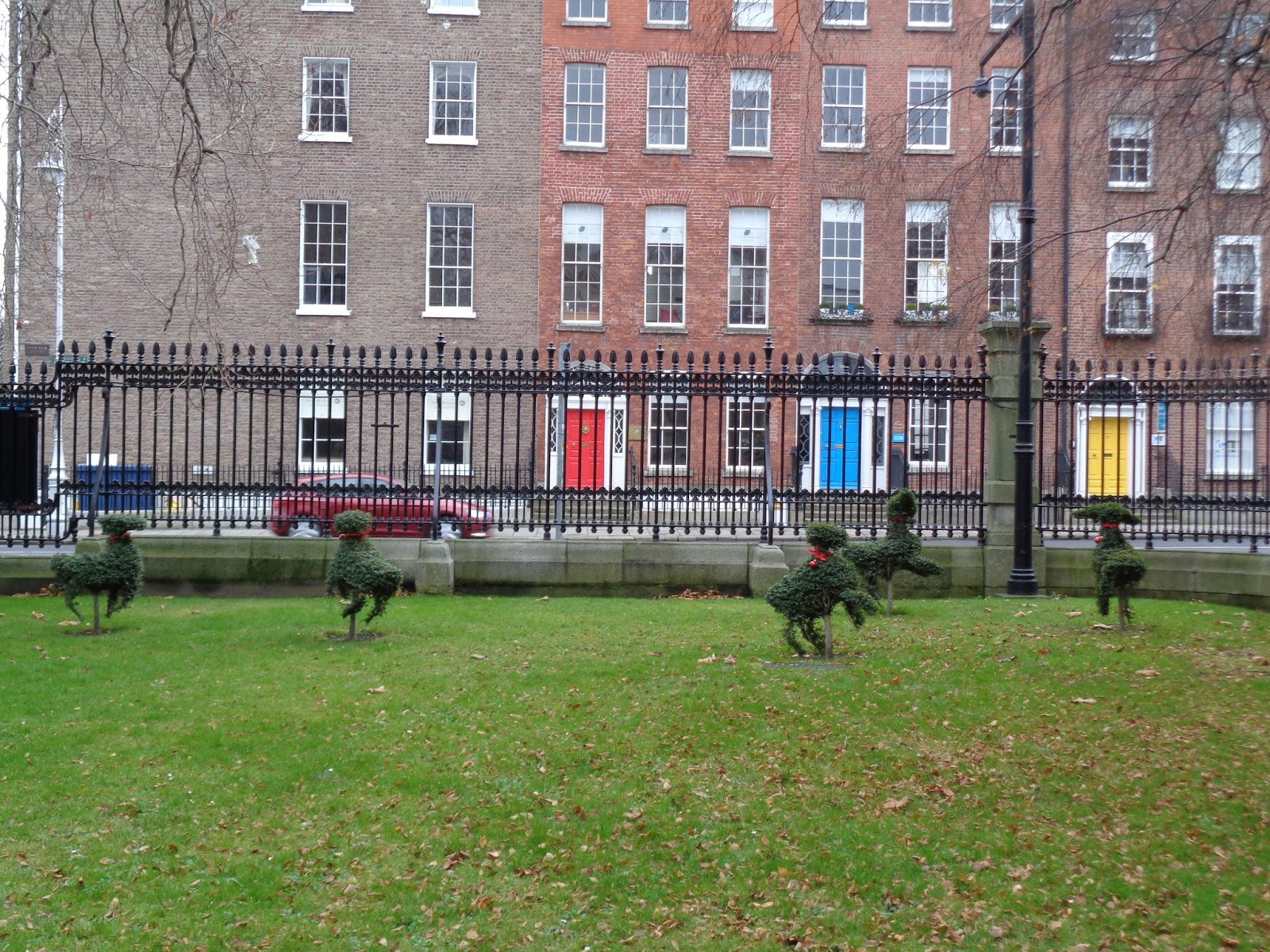
On the lawn outside the “Dead Zoo” (aka Ireland’s National Natural History Museum), five deformed sheep-shaped bushes frolic with red Christmas ribbons around their necks.

Sheep-shaped Christmas Bushes

When we walk into the main hall, we see three giant skeletons of the now extinct Irish elk whose antlers easily reach almost twelve feet tip to tip. These ancient deer—the size of Alaskan moose—once roamed throughout Eurasia from Ireland to Siberia. We call them Irish merely because the most intact remains ever discovered were found in the bogs in Ireland. These three particular specimens are estimated to be around 10,000 years old. Standing under their vast bodies, I begin to imagine what kind of ancient Irish environment could have supported such majestically large creatures. Somehow I can’t imagine them thriving on the endlessly green—and virtually treeless—pastures that currently cover the country.

Kyle admiring the giant elk.

             At the back of the chamber, a display labeled “Conservation” catches my eye. The heading “Green Deserts” is written in tiny font over a cracked display case. The term green desert means an outdoors area that, although uniformly green, lacks biodiversity and actively discourages the development of native plants and animals. Ireland is covered in a wealth of livestock grazing fields, cultivated public parks, and home gardens. Most of the tourist appeal of Ireland comes from a longing to engage with its idyllic pastoral landscape of rolling green hills ripe with lambs and shaggy cattle. Unfortunately, this deceptively lush landscape is often the result of widespread deforestation, herbicide overuse, monoculture, and aggressively maintained horticultural order. Native Irish plants and animals (like the once widespread Irish elk) have little chance of survival. 
When the first humans arrived on Ireland around 9,000 years ago (7,000 BCE), the island was blanketed in forests of Oak, Elm, and Scots Pine.  By 4,000 BCE, the forest began to decline. Over the next 5,000 years, both the Elm and Scots Pine died out completely.  By 1900, the once extensive Irish forests were virtually nonexistent, covering only 1.5% of Ireland. Scientists believe that industrialization, population growth, and the clearing practices of Scottish, Welsh, and English settlers caused this mass extinction.

Clear cut forest remains.
Since 1900, afforestation efforts have built the forest back up to around 10% land coverage in 2006. Unfortunately, commercial timber species make up close to 75% of these woodlands.

Commercial (& invasive) lodgepole pine timber stands.
Tree saplings planted in reforestation efforts.

In recognition of the conservation work yet to be done, the Natural History Museum display encouraged locals to plant “wild gardens” filled with biologically diverse native plants species that will attract native wildlife, creating mini-ecosystems. The display also pointed to the potential for Ireland’s numerous hedgerows to serve as wildlife corridors. A living fence of trees, shrubs, and bushes border most pastures and roads in rural Ireland.  If these hedgerows are allowed grow with minimal trimming, native animals can use them as shelter and biological highways.

A Unique Water Conservation Technique

            On the recommendation of Google, we went to Brother Hubbard’s for brunch our second morning in Dublin. After enjoying a wonderful Middle Eastern/Irish fusion brunch, I went to the restroom to discover something awesome above the toilet.  

The sink above the toilet. (Photo courtesy of Kyle Ackerman)

 The sign barely visible in the upper righthand corner read:


I washed my hands in the gushing water. The sink ran for at least 60 seconds, stopping only when the toilet tank was full.  The experience made me viscerally aware of how much water it takes to flush a toilet.


For more information about the history of Irish forest, go here!

Thursday, January 5, 2017

The Rocky Road to Dublin

Why WWOOF? 
The beginning of this dream to WWOOf in Ireland came to us (Kyle & me) about a year ago celebrating New Years in Santa Marta, Colombia. I, however, have been dreaming of this moment for almost 7 years. 
I first learned about WWOOFing from my college orientation leader in the fall of 2010. Jeannette had spent a year WWOOFing in Latin America between her junior and senior years at Yale. She described her experience as a time of arduous manual labor and deep personal growth.
            My sophomore year at Yale I experienced academic burnout. I studied constantly, but a numbing T.V. static buzzed constantly inside my head, making it impossible to concentrate. I thought I wouldn’t make it through the semester. Remembering Jeannette’s story, I rushed to purchase a WWOOFing membership to volunteer on organic farms in Central America. Luckily, by December, the TV static had faded and I decided to stay at Yale.  Regardless, in the hard months that autumn, the idea that I could escape to the fertile soils of Central America allowed me to push forward.
            A year later, reeling from a relationship’s deterioration, I decided it was time to escape for real. I spent spring of my junior year at a university in Galway, Ireland.  After a semester of wandering down muddy cow paths and climbing into trees that overlooked horse pastures, I had a realization: my soul and body feed on fresh air, physical activity, and engaging with the outdoors (especially in times of uncertainty and hardship).
            Struggling to readjust to Yale’s breakneck pace the following fall, I remembered what I’d learned about myself in Ireland and signed up to volunteer at the sustainable farm.   Every Sunday of my senior year—come sun, rain, ice storm or polar vortex—I walked uphill twenty minutes to the farm. Whether I was pulling weeds beneath giant Brussels sprout leaves or planting tiny seeds in neat rows in the green house, I felt a much missed—and previously lacking—sense of peace and purpose.
            Now, about two years later, I find myself once again lost. I quit my teaching job because severe anxiety (along with other issues) made it impossible for me to both do my job and take care of myself. Since then I've been recuperating. For the first time in my life, I don’t know where I will be in a year’s time. The road ahead of me is muddled with unknowns and plagued with uncertainty. Sweating in the cold, rainy fields of the Emerald Isle with my beloved boyfriend by my side, I hope to reencounter the peace, purpose, and clarity that grow in fresh dirt. That is why I want to WWOOF.

The Adventure Begins
Well, it’s less than 12 hours before our flight leaves for Ireland! Bags packed and passports double-checked, we are ready for an adventure:


Keep your eyes peeled for a post announcing our safe arrival in Dublin on Saturday!

Also, click the link to check out the Rocky Road to Dublin Song. :) 


Tuesday, December 20, 2016

WWOOF: What the heck does it stand for??


The Mission & The Acronym
Before I start telling my specific story, I need to clarify the term WWOOF. Although most of us have a vague understanding of what it means (hippies? farms? cheese making??), the exact meaning of the acronym WWOOF is shrouded in confusion. I, myself, confidently thought that it stood for World Wide Organization of Organic Farms until a few minutes ago when I began doing research for this very blog post!
According to the main WWOOF website, WWOOF stands for World Wide Opportunities on Organic Farms. A few other interesting interpretations include: Working Weekends On Organic Farms, Willing Workers On Organic Farms, and We’re Welcome On Organic Farms.
Regardless of the precise interpretation you subscribe to, the mission behind each WWOOF meaning is the same: to create a more sustainable, connected world through cultural exchange and voluntary labor on organic farms.
A Quick Grammar Lesson
WWOOF is an acronym at its heart, but in colloquial speech it is treated like a verb and all verb-related grammar rules apply.

INFINITIVE: To WWOOF
PRESENT TENSE: I currently WWOOF on Susy Q’s quail farm.
PAST TENSE: Dracula WWOOFed for two weeks in Transylvania.
GERUND FORM: I am WWOOFing my ass off digging potatoes in Idaho!

WWOOF, similar to other verbs, can be turned into a noun when speaking about the person who does the action. A person who WWOOFs is called a WWOOFer. This should not to be confused with the similar sounding—and equally cool—acronym WFR (pronounced “woofer”). Such confusion could lead to disaster in some situations!
For example, if you received the voicemail: “Help! Help! I’ve been attacked by an angry grizzly bear and I’m bleeding to death. I need a WFR now!!”, the appropriate response would not be to send a wonderful organic farm volunteer. As awesome as WWOOFers are, sending a WFR (Wilderness First Responder) to help would be a much better choice. J